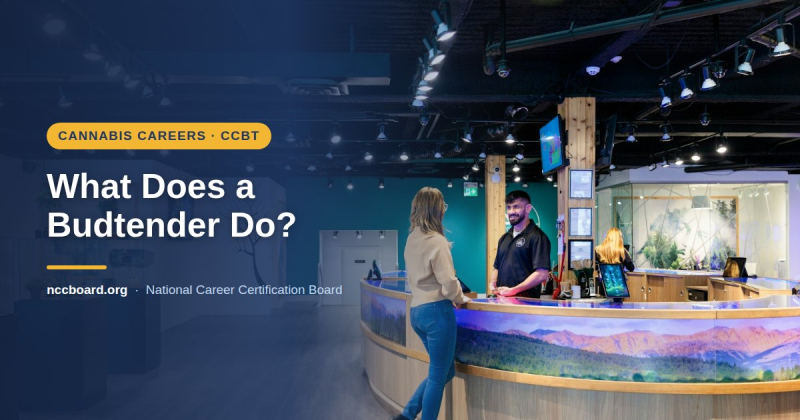
A woman in her sixties walks into a dispensary for the first time. Her doctor mentioned that some patients find cannabis helpful, and she's curious, but she's also nervous. She doesn't know the words. She's not even sure she's allowed to ask questions.
The person behind the counter is the one who makes or breaks that visit. That person is the budtender.
If you've ever thought budtending was just a laid-back retail job, it's worth a closer look. The role takes real product knowledge, strong people skills, and careful attention to the law. Here's what the job actually involves and how to get hired.
What does a budtender do?
A budtender is a dispensary employee who helps customers choose cannabis products and completes their purchases. Budtenders check IDs and medical cards, explain different products and how they're used, answer questions, and handle sales in a way that follows state law. They're part product guide, part customer service pro, and part compliance officer.
Think of a wine shop with a much stricter rulebook
Here's a helpful comparison. A good wine shop employee knows their products well. They can tell you which bottle goes with dinner and why. They ask what you like, then point you in the right direction.
A budtender does something similar. But imagine that wine shop had to verify every customer's age, track every bottle from the vineyard to the register, follow strict limits on how much each person can buy, and avoid making any health claims about the product. That's closer to the budtender's world. The friendly conversation is only half the job. The other half is getting every detail right.
A day behind the counter
Every dispensary runs a little differently, but most budtenders spend their shifts doing a mix of the following.
Checking IDs and eligibility
This is the first and most important step in every sale. In states with adult-use cannabis, customers typically must be 21 or older. Medical customers may need a valid state medical card. Budtenders confirm this every single time. A missed ID check isn't a small slip. It can put the dispensary's license at risk.
Helping customers choose
Customers come in with all kinds of needs. Some are regulars who know exactly what they want. Others are first-timers who feel overwhelmed. Budtenders ask questions, listen, and explain the options: flower, pre-rolls, vapes, edibles, tinctures, and topicals, along with how each one differs.
Sharing safe-use information
Good budtenders help customers understand how different products work, how long effects can take to show up, and why it's smart for new users to start with a small amount. They share general, accurate information without making promises about treating any health condition. If a customer asks a medical question, a professional budtender suggests they talk with their doctor.
Tracking every sale
Most states require dispensaries to track cannabis products from the moment they're grown until the moment they're sold, often called seed-to-sale tracking. Budtenders enter sales accurately, follow purchase limits, and handle cash and payments carefully. Clean records keep the business in good standing with regulators.
Keeping the floor running
Between customers, budtenders restock displays, check inventory, keep the space clean, and stay current on new products. When a new edible or strain comes in, customers will ask about it, so it pays to learn fast.
What skills make a great budtender?
Dispensary managers look for a mix of knowledge and personality. The best budtenders usually have these strengths:
- Product knowledge. You understand strains, product types, and consumption methods well enough to explain them clearly.
- Compliance awareness. You know the rules and follow them every time, even when the store is slammed.
- Warm, patient service. You can make a nervous first-timer feel welcome and a busy regular feel appreciated.
- Clear communication. You explain things in plain language without talking down to anyone.
- Accuracy with numbers. You handle cash, weights, and purchase limits without mistakes.
- Good judgment. You know when to decline a sale, when to call a manager, and when to suggest someone talk with a doctor.
- Discretion. Many customers value privacy. You respect it.
Notice that enthusiasm for cannabis isn't on the list by itself. Liking the plant is fine. But dispensaries hire people who understand the job, not just the product.
Where can you work as a budtender?
That depends entirely on where you live. Cannabis laws vary widely from state to state. According to the National Conference of State Legislatures, 41 states, three territories, and the District of Columbia allow medical cannabis, and 24 states, three territories, and D.C. allow or regulate non-medical adult use (NCSL). Those laws keep changing, so always check the current rules in your state.
Some dispensaries serve only medical patients. Others serve adult-use customers, and some serve both. Medical dispensaries may call for extra care, since many customers are managing health conditions and want to feel understood.
How do you get hired as a budtender?
Here's a practical path many people follow.
- Check your state's rules. Find out whether dispensaries operate where you live, the minimum age to work in one, and whether workers need to register with the state.
- Learn what registration involves. Many states require dispensary employees to be registered or badged. In Massachusetts, for example, dispensary owners, employees, and volunteers must be registered as agents with the Cannabis Control Commission, and a background check is part of the process (Massachusetts CCC).
- Build your knowledge. Study product types, cannabis basics, customer service, and compliance. A training program or self-study with good materials can help.
- Get certified. A credential shows employers you already understand the role before your first shift.
- Polish your resume. Highlight retail, hospitality, or cash-handling experience. Put your certification near the top.
- Prepare for the interview. Expect questions about ID checks, how you'd help a first-time customer, and what you'd do if someone tried to buy more than the legal limit.
Why certification gives you an edge
Dispensary managers have a tough job. One careless employee can lead to fines or worse. So when two candidates apply and one can prove they already understand compliance, product education, and customer care, that candidate stands out.
The NCCB Cannabis Budtender Certification (CCBT) shows employers that you understand compliance basics like ID checks, medical card verification, and sales tracking. It also shows you can educate customers about products and safe use with accuracy and confidence.
The CCBT exam has 80 questions with a 2-hour time limit, and you'll need a score of 70% or higher to pass. You take it online from home with secure proctoring, and you can test anytime within 30 days of purchase. If you want to check your readiness first, NCCB practice exams use questions from the real test bank.
Common questions about budtending
How old do you have to be to work as a budtender?
It depends on your state. Many states set the minimum age at 21 to work in a dispensary, but the rules aren't the same everywhere. Check with your state's cannabis regulator before you apply.
Do budtenders need a license?
Some states require dispensary workers to register with the state or carry an agent badge, and that often includes a background check. Others don't. This registration is separate from a professional certification. Registration gives you permission to work in a dispensary. Certification shows employers you know how to do the job well.
Is budtending a good long-term career?
For many people, it's a first step. Budtenders who learn the business often move into roles like lead budtender, inventory specialist, compliance coordinator, or dispensary manager. The knowledge you build on the sales floor carries into all of those jobs.
Can a budtender give medical advice?
No. Budtenders can share general information about products and safe use, but they shouldn't diagnose conditions or promise that a product will treat a health problem. If a customer has medical questions, the professional move is to point them to their doctor.
The bottom line
Budtenders are the face of the cannabis industry. For many customers, the budtender is the only person they talk to about cannabis at all. That's a real responsibility, and it's also what makes the job rewarding. You get to help people feel safe, informed, and respected.
If you're ready to walk into your next interview as the candidate who already knows what the job demands, learn more about the Cannabis Budtender Certification (CCBT).
Cannabis laws differ by state and change often. This article is for general information only and isn't legal advice. Always check the current rules in your state.
References
- National Conference of State Legislatures. "State Medical Cannabis Laws." https://www.ncsl.org/health/state-medical-cannabis-laws
- Massachusetts Cannabis Control Commission. "Guidance on Agent Registration." https://masscannabiscontrol.com/wp-content/uploads/2018/08/202107_Guidance_Agent_Registration.pdf
- National Career Certification Board. "Cannabis Budtender Certification (CCBT)." https://nccboard.org/certification/cannabis-careers/cannabis-budtender-certification-ccbt