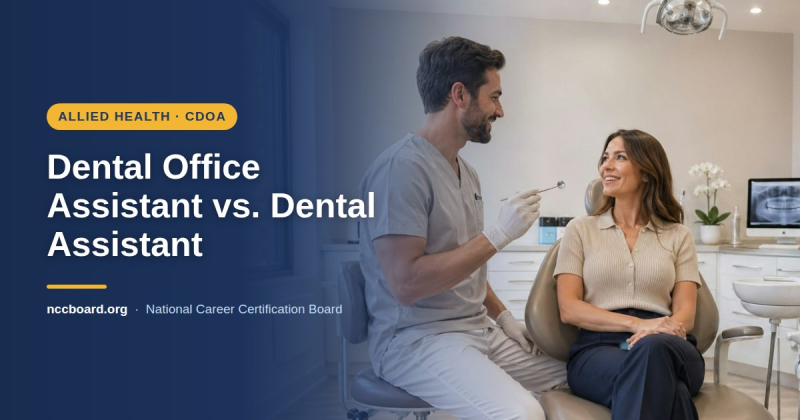
Think about the last time you went to the dentist. Before anyone looked at your teeth, someone greeted you, checked your insurance, and told you the hygienist would be right out. Later, in the chair, someone else handed the dentist tools and helped keep your mouth dry.
Those might have been two different people with two different jobs. Or, in a smaller office, they might have been the same person wearing two hats.
If you're thinking about a career in a dental office, it helps to understand the difference between a dental office assistant and a dental assistant. The titles sound almost the same, but the day-to-day work can be very different.
What's the difference between a dental office assistant and a dental assistant?
A dental office assistant focuses on the business side of the practice: scheduling, patient check-in, records, insurance, billing, and keeping the office running smoothly. A dental assistant focuses on the clinical side: preparing patients, sterilizing instruments, and helping the dentist chairside during procedures. Many offices blend the roles, so strong office assistants often understand both.
Think of a restaurant: front of house and kitchen
A busy restaurant has two worlds. The front of the house is where guests are greeted, seated, and billed. The kitchen is where the food gets made. Both matter. A great meal served by a rude host still leaves a bad taste, and a friendly host can't save a burned steak.
A dental practice works the same way. The dental office assistant runs the front of the house. The dental assistant works in the kitchen, right beside the dentist. When both sides are strong, patients leave happy and come back.
What a dental office assistant does
Dental office assistants keep the practice organized and patients moving. On a typical day, they might:
- Greet patients and check them in
- Schedule appointments and manage the daily calendar
- Confirm upcoming visits and fill last-minute openings
- Verify insurance and explain coverage to patients
- Enter treatment codes and process claims
- Handle billing, payments, and payment plans
- Keep patient records accurate and private
- Answer phones and respond to patient questions
A big part of this job is knowing dental codes. The American Dental Association maintains the Code on Dental Procedures and Nomenclature, known as the CDT Code. Its purpose is to make sure dental treatment is reported in a uniform, consistent, and specific way, and it's updated every year (ADA). A small coding error can lead to a denied insurance claim, so accuracy here really matters.
In many offices, dental office assistants also help with basic clinical support when things get busy, such as preparing rooms or helping patients feel comfortable. Knowing how the clinical side works makes you better at the front desk, too, because you can answer patient questions with confidence.
What a dental assistant does
Dental assistants work mostly in the treatment room. According to the U.S. Bureau of Labor Statistics, their duties include making sure patients are comfortable in the chair, sterilizing instruments, handing instruments to dentists during procedures, and using suction to keep patients' mouths dry. Under a dentist's supervision, they may also take x-rays and prepare materials for impressions or temporary crowns (BLS).
Here's an interesting detail. BLS also lists administrative tasks as part of the dental assistant role, including scheduling appointments, keeping treatment records, and working with patients on billing and payment (BLS). That overlap is exactly why the two jobs get confused. In real offices, the line between front desk and chairside is often blurry.
A side-by-side look
| Dental Office Assistant | Dental Assistant | |
|---|---|---|
| Main focus | Front office and practice operations | Chairside clinical support |
| Key tasks | Scheduling, insurance, CDT coding, billing, records | Patient prep, sterilization, instrument handling, x-rays |
| Where you'll spend your day | Front desk, phones, computer | Treatment rooms, beside the dentist |
| State rules | Usually few or no state requirements | Varies by state, especially for x-rays and some procedures |
| Best fit for | Organized people who like systems and customer service | Hands-on people who enjoy clinical work |
What about state rules?
This is where the two paths differ most. Clinical dental work is regulated by the states, and the rules vary a lot. BLS notes that states typically don't require licenses for entry-level dental assistants. However, states may require dental assistants to meet specific requirements to work in areas like radiography (x-rays) or infection control (BLS).
If you're leaning toward chairside work, check your state's rules first. The Dental Assisting National Board keeps a state-by-state guide to dental assistant job titles, education pathways, and allowed duties.
Front office roles generally don't carry the same state requirements. That makes the dental office assistant path a faster way into the field for many people. It's also a natural stepping stone. Some front office staff later move into clinical roles, while others grow into office manager or practice administrator positions.
What does the job market look like?
Dental offices are steady employers. BLS reports that dental assistants held about 388,600 jobs in 2025, with employment projected to grow 7 percent from 2025 to 2035. That's much faster than the average for all jobs, with about 53,000 openings expected each year. The median annual wage for dental assistants was $48,070 in May 2025 (BLS).
Pay for front office roles depends on location, experience, and how much responsibility you take on. People who master scheduling, insurance, and coding tend to become the person the whole office leans on, and that kind of value gets noticed.
A morning at the front desk
To make this real, here's what the first few hours might look like for a dental office assistant.
At 7:30, before the doors open, you check the day's schedule. Two patients need insurance verified, and one appointment still hasn't been confirmed. You make a quick call and fill a gap left by last night's cancellation.
At 8:00, the first patients arrive. You greet them by name, update their forms, and answer a question about what their plan covers for a crown. In between check-ins, a claim comes back denied because of a coding mismatch. You fix the code and resubmit it.
By 10:00, the dentist is running fifteen minutes behind. You let waiting patients know, offer to reschedule anyone in a hurry, and keep the waiting room calm. Nobody sees half of what you do, but the whole morning runs because of it.
Which role fits you?
Ask yourself a few questions.
Do you love keeping things organized?
If you get satisfaction from a clean calendar, a solved billing problem, or a patient who leaves the front desk smiling, the office side may be your home.
Do you want to be hands-on with patients?
If you're drawn to the clinical action and don't mind the sights and sounds of dental work, chairside assisting may suit you better.
Why not both?
In smaller practices especially, the most valuable team members can move between the front desk and the treatment room. Understanding both sides makes you harder to replace.
Common questions
Do I need a degree to work in a dental office?
Usually not for front office roles. Many employers look for a high school diploma plus strong computer, communication, and customer service skills. Clinical roles may require state-approved training depending on where you live.
Is it hard to learn CDT codes?
It takes practice, but it's very learnable. Most people learn the common codes quickly by using them every day. Because the code set is updated every year, good office assistants make a habit of checking for changes.
Can a dental office assistant move into management?
Yes. Many office managers and practice administrators started at the front desk. The skills you build in scheduling, billing, and patient relations are the foundation of running a practice.
How certification helps
Dental practices don't just hire assistants. They hire people they can rely on. The NCCB Dental Office Assistant Certification (CDOA) shows employers you understand the full scope of dental office operations, including front desk management, clinical support, patient care, and CDT coding. It tells a busy dentist you can contribute from your first week without a long learning curve.
The exam has 80 questions and a 2-hour time limit. A score of 70% or higher earns your certification, and you can test online from home whenever you're ready. Want to check your readiness first? Try an NCCB practice exam.
The bottom line
Dental office assistants and dental assistants are two halves of the same team. One keeps the practice running. The other keeps procedures running. Both are rewarding, stable careers, and the skills overlap more than most people expect.
If the front of the house is calling your name, make sure employers know you're ready. Learn more about the Dental Office Assistant Certification (CDOA).
References
- U.S. Bureau of Labor Statistics. "Dental Assistants." Occupational Outlook Handbook. https://www.bls.gov/ooh/healthcare/dental-assistants.htm
- American Dental Association. "The Code on Dental Procedures and Nomenclature (CDT Code)." https://www.ada.org/publications/cdt
- Dental Assisting National Board. "State Requirements." https://www.danb.org/state-requirements
- National Career Certification Board. "Dental Office Assistant Certification (CDOA)." https://nccboard.org/certification/allied-health-careers/dental-office-assistant-certification-cdoa